Home Services   › Elevated Concrete Decks   › Limestone Retaining Walls   › Bundled Site Solutions   › Upper-Level Patios Service Areas   › New Braunfels & Comal County   › Canyon Lake & Spring Branch   › Boerne & Kendall County   › Dripping Springs & Hays County   › Blanco County & Johnson City Process About Blog FAQ Contact
HomeServicesLimestone Retaining Walls

SECONDARY SERVICE

Limestone Retaining Wall Builder

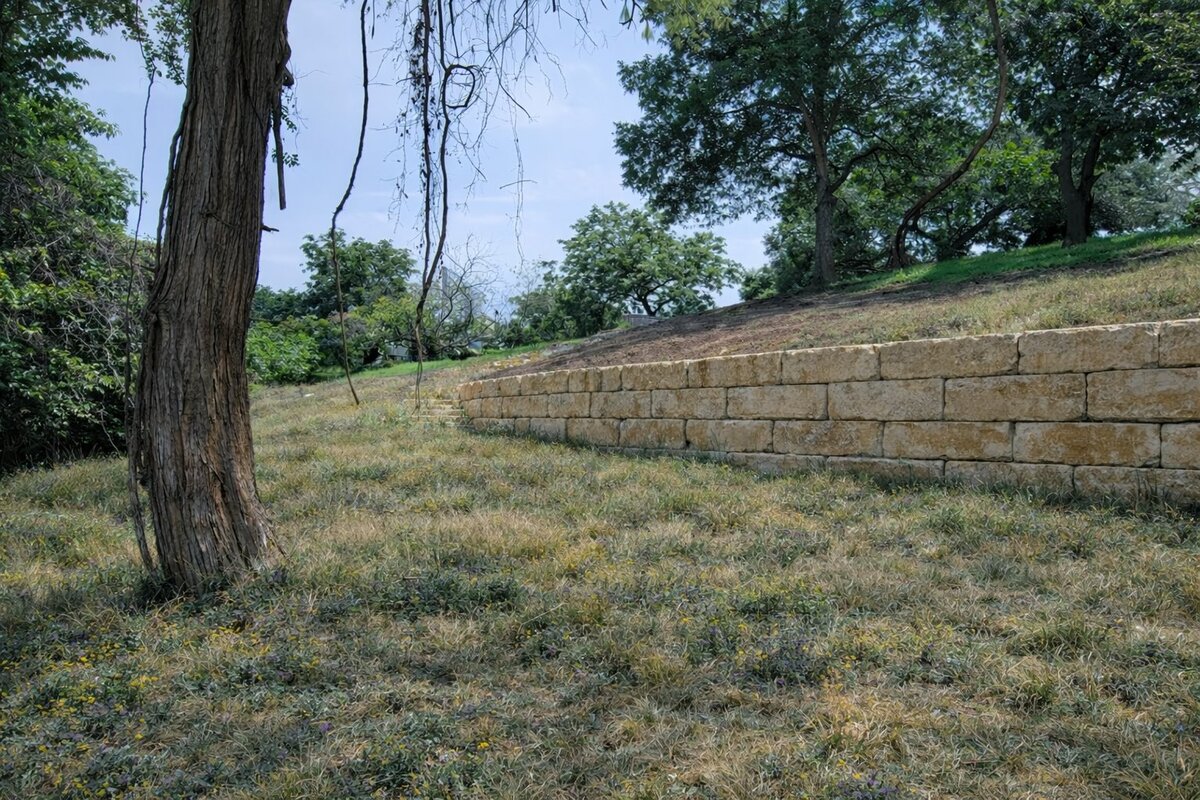
Gravity-stacked Hill Country quarry blocks — no mortar, no maintenance, built for Texas terrain.

Gravity-stacked Hill Country limestone quarry block retaining wall

The Right Wall for Hill Country Terrain

Texas Hill Country limestone retaining walls built with large quarry blocks — the same native stone that defines the landscape. Gravity-stacked construction uses the natural weight and interlock of oversized blocks to retain earth, manage drainage, and create level usable space on sloped lots without a single drop of mortar.

The result is a wall that looks like it belongs here, because the material comes from here. Natural color variation, authentic texture, and a character that integrates with the surrounding terrain rather than fighting it.

No mortar. No maintenance. Gravity-stacked limestone moves naturally with soil and allows drainage through the wall face — eliminating hydrostatic pressure buildup that fails mortared walls.

What We Build Limestone Walls For

Hillside Terracing

Converting a steep, unusable slope into tiered flat areas for outdoor living, landscaping, or additional building pads. Most effective when combined with an elevated deck above.

Driveway & Entrance Stabilization

Retaining the grade along ranch entrances, driveways, and gated access roads on acreage properties where the road cuts through a slope.

Drainage Management

Directing seasonal runoff away from the home and toward proper drainage routes. Correctly sized and positioned walls prevent erosion and property damage during Hill Country rain events.

Property Definition

Marking boundaries on ranch and estate properties using a material that blends naturally with the surrounding landscape rather than standing out as a manufactured product.

Why Gravity-Stacked vs. Mortared

Mortared limestone walls are common in landscape construction. They look similar at installation but behave differently over time. In Hill Country terrain with significant soil movement, freeze-thaw cycles, and seasonal saturation, mortared joints crack. Once a mortared wall cracks, water infiltrates the joint, the problem accelerates, and repair is expensive and visible.

Gravity-stacked walls built with large quarry blocks move with the soil rather than fighting it. Individual blocks can be reset if settling occurs — a straightforward repair. The wall also drains naturally through the block faces, eliminating the hydrostatic pressure buildup that fails mortared walls from behind.

For long-term structural performance in Hill Country conditions, gravity-stacked construction is the right choice.

Backyard Leveling Solutions for Hill Country Properties

The most common reason Hill Country property owners search for a backyard leveling contractor is a slope that has made portions of their yard unusable — a strip of hillside behind the house that erodes with every rainstorm, a drop-off that prevents a functional patio, or a grade change that eats up space they’d rather use for outdoor living.

Traditional backyard leveling means grading, hauling in fill dirt, compacting, and hoping the soil holds. In Hill Country conditions — shallow soil over caliche and limestone bedrock — this approach frequently fails. The fill washes out. The grade shifts. What was supposed to be permanent becomes an annual maintenance headache.

Gravity-stacked limestone retaining walls solve the same problem with a fundamentally more durable approach: instead of forcing the soil to hold a new grade, the wall creates a permanent terraced structure that the soil sits behind. Large Hill Country quarry blocks provide the structural weight; no mortar is required; the natural interlock of the blocks provides decades of stability.

The result is genuine, permanent backyard leveling — often at a cost comparable to conventional grading, but with a 30-plus-year lifespan and a finished appearance that complements Hill Country architecture.

At a Glance

No mortar

Gravity-stacked construction

Local material

Hill Country quarry blocks

Zero maintenance

No sealing, no repointing

Natural drainage

No hydrostatic buildup

Scope-dependent

Timeline per project

Fixed price

No change orders

Common Questions

Do I need a retaining wall?

If your property has slopes causing erosion, drainage running toward the home, grade changes that make outdoor space unusable, or a driveway that’s cutting through a hillside — a retaining wall likely solves the problem. The free site consultation will tell you definitively whether one is needed and where to place it.

Can I combine a retaining wall and elevated deck?

Yes — this is our most common combined project. The retaining wall terraces the slope below; the elevated deck provides the outdoor living platform above. One crew, one mobilization, one schedule. See the Bundled Site Solutions page for more detail.

What does a limestone retaining wall cost?

Wall cost depends on length, height, and site access. We provide fixed-price proposals after a site visit — there is no reliable way to price a retaining wall without seeing the terrain. Call (210) 336-0757 to schedule a free consultation.

Ready to discuss your property?

Free site consultation. Fixed pricing. Natural Hill Country limestone.

Also see: Elevated Concrete Decks · Bundled Site Solutions · FAQ